Contrast Sensitivity Test
Read letters that get progressively lighter against a white background and see the lowest contrast you can make out. This is an informal test, not an eye exam.
Set your screen brightness to maximum, desligue o modo noturno ou filtro de luz azul, use os óculos de costume e fique a cerca de um braço de distância. Cada letra fica mais clara a cada nível: escolha qual você vê, ou I can't see it.
Informal on-screen test; not an eye exam. Tip: You can also answer by pressing the letter on your keyboard.
Your result
—
Results depend on your screen's brightness and quality. Compare only tests taken on the same device under the same conditions.
Processed on your device. Nothing you type is sent anywhere.
How to use: Contrast Sensitivity Test
- Set your screen brightness to maximum, sit about 50 cm (or an arm’s length) away, and wear your usual glasses.
- For each letter, choose the matching option or Can’t see it. Each level has up to 3 letters; get 2 right to move on to the next, lighter level.
- The test stops after 2 incorrect answers at a level. See the lowest contrast you could read and share your result.
About this tool
Visual acuity and contrast sensitivity aren't the same
A standard eye exam measures visual acuity: how well you can read sharp, black letters that get smaller and smaller. Contrast sensitivity measures something different: how well you can see large but faint objects, like a gray step at dusk or a pedestrian in the fog. That's why someone with 20/20 vision can still have trouble seeing in low light.
This test follows the idea behind letter-based contrast tests: the letters stay the same size and get lighter at each level, from 50% to less than 1% contrast against a white background. The displayed contrast accounts for color rounding on your screen.
This is an informal test: your screen affects the results
Brightness, glare, viewing angle, and monitor calibration can all affect what you see. Use the result for curiosity and comparison on the same device, not for diagnosis. Contrast sensitivity often decreases with age and with conditions like cataracts and glaucoma. If you notice that it's getting harder to see at night or in low light, see an eye doctor.
For color vision, try the color blindness test.
Frequently asked questions
Does this test replace an eye exam?
No. Screens aren’t calibrated, and your surroundings can affect the results. This is an informal test; an eye doctor can diagnose vision problems.
What’s a good result?
On a typical screen with the brightness turned up, reading letters with less than 2% contrast is excellent, and around 4% is good. Below 1%, the screen itself may not be able to show a difference.
Why is the background white?
A white background lets the screen display shades of gray that are closer to the background, making it possible to test lower contrast levels. Turn off night mode or any blue light filter before you start.
Is it really free? Is there a daily limit?
It's free with no daily limits. Processing happens on your device, so there's no per-use cost and no need to limit you.
Does it work on phones?
Yes. The site works in any modern browser on Android, iPhone, Windows, Mac, and Linux—no installation needed.
Related tools
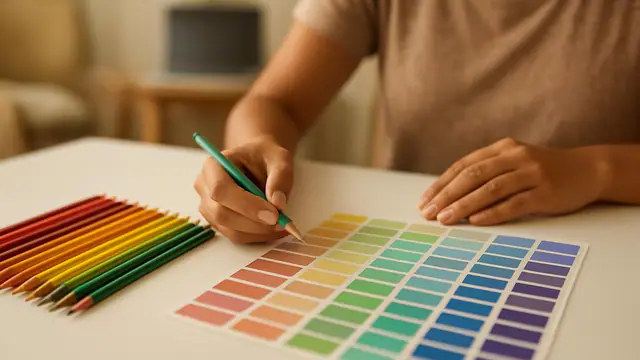 Color Blindness Test
Read the numbers hidden in 10 color-dot plates and find out if you should consider getting a color vision exam.
 Online hearing frequency test
Listen to tones from 60 Hz to 20 kHz generated in your browser and find out the highest and lowest frequencies you can hear. This isn't a medical test.
 Attention Test
Find the odd symbol in 20 grids that grow from 4×4 to 7×7. Race the clock and see your accuracy and speed.
 Adjust Brightness and Contrast
Brighten, darken, and enhance photo colors with a real-time preview.
 Microphone test
Check if your microphone is working with a live audio level, a 5-second recording, and troubleshooting tips.
 Reaction Time Test
Click as soon as the screen turns green. See your average time across 5 attempts in milliseconds, with early clicks detected.
 Memory Test
Memorize sequences of numbers or colors that get longer with each correct answer and find out how many items you can remember.
 Internet Speed Test
Measure download and upload speeds, ping, and jitter between your device and our server—no installation required.